Resource Parents
Click through the tabs to learn more about being a resource parent and explore resources offered to current and prospective resource parents!
Commonly Used Acronyms

The acronyms and abbreviations in this document are common to social work and child welfare services in San Luis Obispo County. Familiarizing yourself with these acronyms helps prevent miscommunication or misunderstanding and allows you to better navigate the system. To view the document, click here!
Additionally, the San Luis Obispo County Department of Social Services has created an extensive list of acronyms that are commonly used among various county government agencies and programs. To view the document, click here!
Family Engagement

As a Resource Parent, you’re an important member of the child’s support team. This page shares tools for engaging with birth families, participating in CFT meetings, and supporting healthy, connected visitation.
Child & Family Team Meetings
What is a Child Family Team?
- Child and family team means a group of individuals who are organized by the placing agency and who are engaged through a variety of team-based processes to identify the strengths and needs of the child or youth and theirfamily, and to help achieve positive outcomes for safety, permanency, and well-being.
How does the Child and Family Team support the family through meetings?
- Providing input into the development of a child and family plan that is strengths-based, needs-driven, and culturally relevant.
- Providing input into the placement decision made by the placing agency and the services to be provided to support the child or youth.
Resources
Supporting Reunification
Explore the listed resources to learn more about the importance of reunification, and how you can best support reunification as a resource parent!
Frequently Asked Questions

Becoming a resource parent is a big step and can truly make a difference in the lives of our youth in care. Our department is eager to come alongisde prospective resource parents, answer questions, and guide them through the process!
What is a Resource Parent?
A resource parent, or resource family, is the new umbrella term used in the state of California to refer to adoptive or foster parents and many other types of out-of-home caregivers. They are trained and approved to provide foster and adoptive care to children and teenagers.
Resource parents play a vital role in the department’s commitment to helping children and teens find success at home, at school and in their communities.
To find out more, call (805) 781-1705.
How do I become a Resource Parent?
Are you ready to take the next step and make a difference in a child or teen’s life?
The process to become a resource parent typically takes around 90 days, but there are many factors that can affect your timeline.
If you decide to make a difference in the life of a youth in foster care and move forward with the application process, the department will assist you and support you through the process
You can begin the application process by calling (805) 781-1705 or submitting your interest via our online eform.
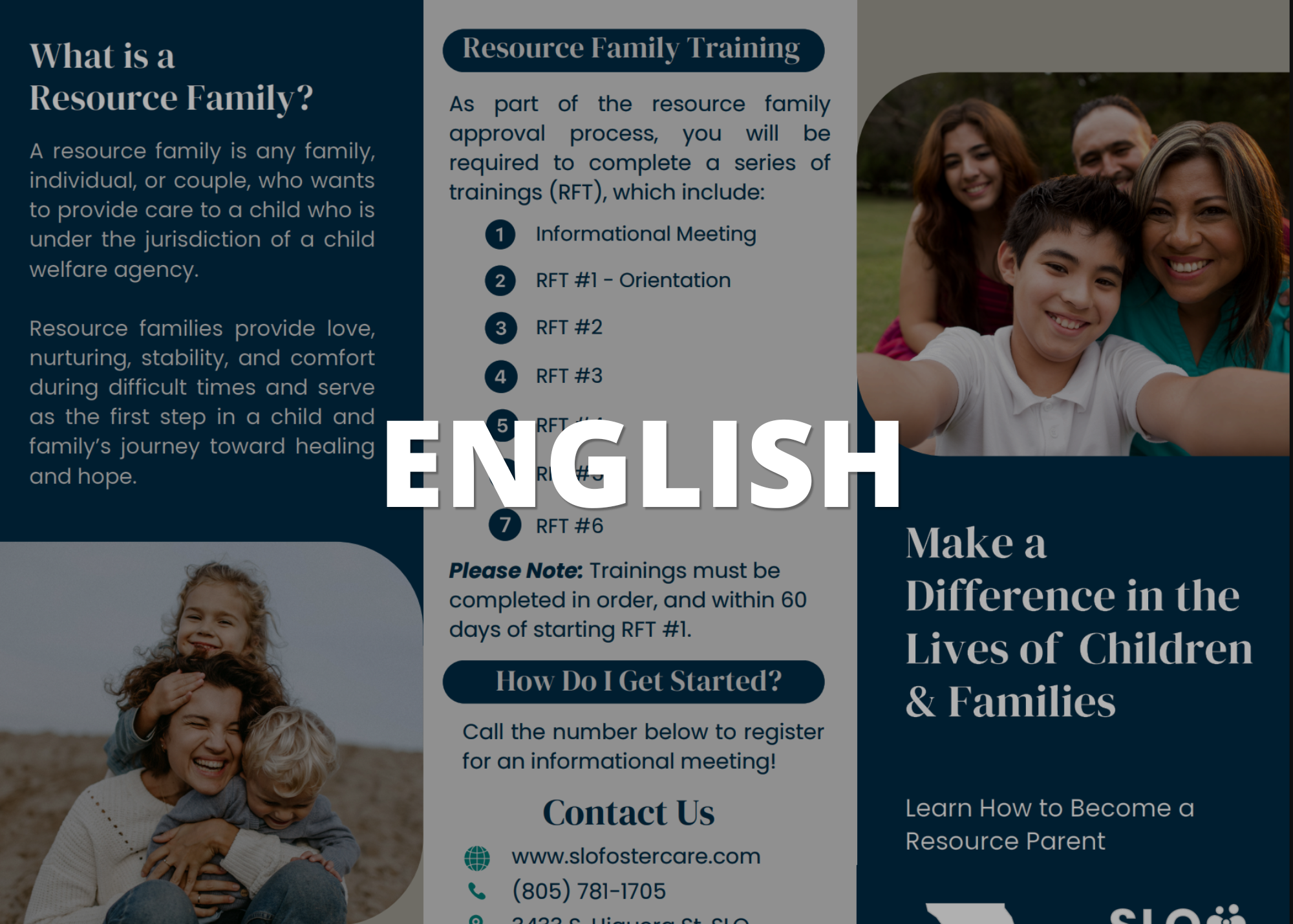
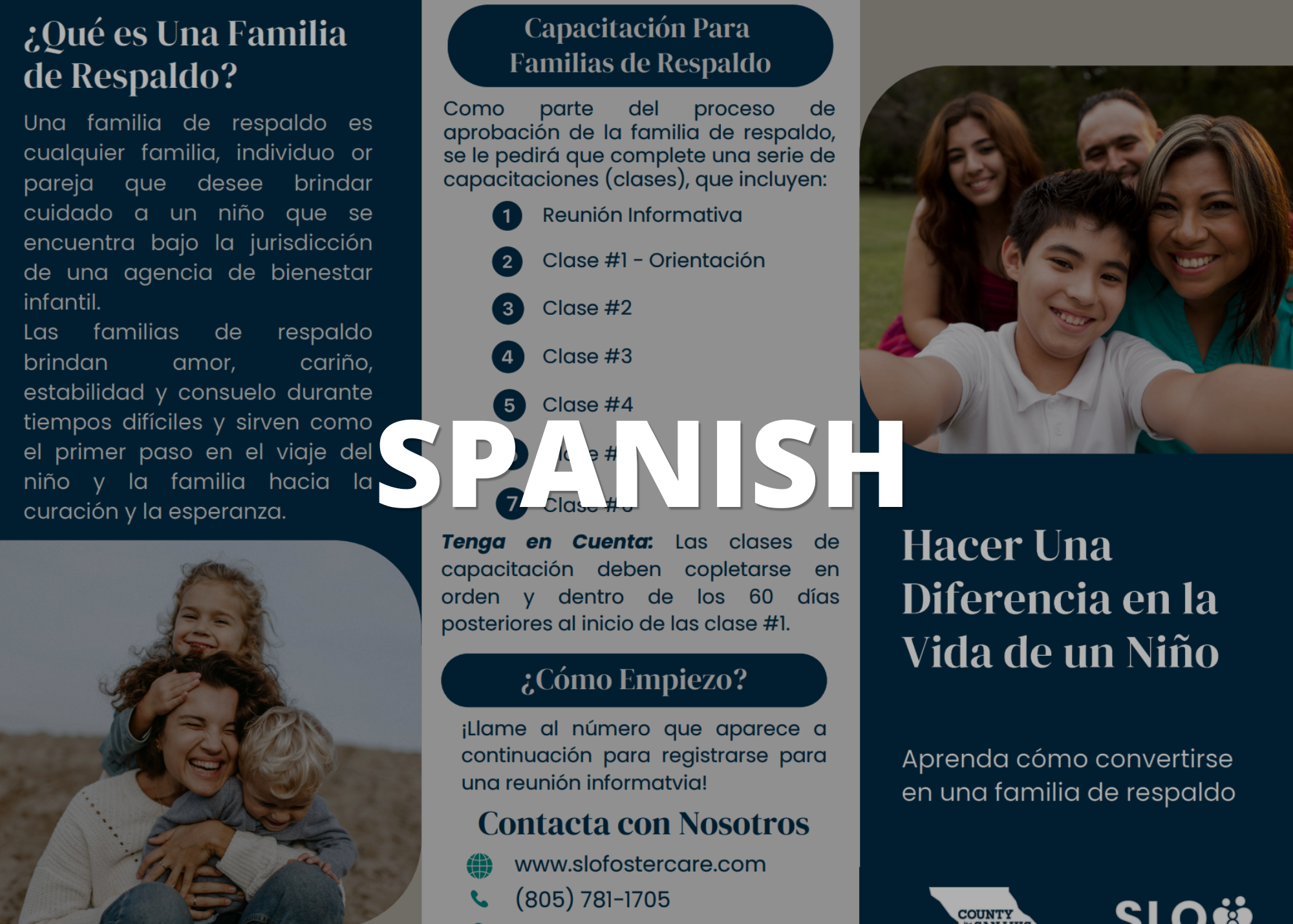
To learn more, check out this brochure in English or Spanish.
Specialty Foster Care
Resource parents are an “umbrella term,” to the various roles they can play within the foster system. Not all resource parents commit to long-term placements.
Emergency Shelter Caregiver:
- These resource parents are committed to emergency, on-call foster care and are available on short notice to provide immediate, temporary care for children ages 0-18 who are entering the foster care system or are waiting for more permanent placements. Without these caregivers the department is often left struggling to find placements for youth who are already experiencing significant trauma.
Respite Care Provider:
- Respite care is a crucial support to those with long-term placements and is an option for those who want to foster but are unable to commit in the long-term. Respite care providers care for foster children for a brief period while the resource parent is unable to. If you’re a resource parent needing assistance, click the ‘Respite Care’ tab to learn more.
Options for Recovery (OFR):
- Resource parents designated as “OFR” are specially trained to support the needs of medically fragile children ages 0-5 and take an active role in the reunification process through mentorship of birth parents.
Financial Support Information

Financial Assistance
Foster parents receive monthly, tax-free, state-specific stipends
to cover food, clothing, and shelter. Additional support may include Medi-Cal for the child, initial clothing allowances, childcare subsidies, and specialized care rates for youth with higher needs.
In addition to monthly foster care payments, the department can also assist with clothing allowances or reimbursing for transporting your child to and from school if the site is more than a three (3) mile drive.
For additional resources (non-financial), check out our foster support tab.
Additional Funding
PEAK Scholarship
The PEAK SLO scholarship helps cover the cost of extracurricular activities that promote connection, skill-building, and positive experiences for youth in your care. Youth must reside within the city of San Luis Obispo to qualify, and funds can be used for things like sports teams, classes, or other enrichment opportunities.
Helpful Articles & Books

As a resource parent, you may find various articles and books that offer valuable insights, support, and guidance in your role as a caregiver. Here are some helpful articles and books that can be beneficial for resource parents. The department is not affiliated with any of the authors and does not profit off of sales of these books.
Articles
Click on any of the articles below for helpful tips and guidance on being a resource parent!
- “How foster parents can support reunification”
- “Why self-care is essential for adoptive, kinship, and other permanency caregivers”
- “Learn how to build meaningful relationships with those in your care”
- “6 ways to support foster youth”
- “10 Ways to Strengthen Foster Parent/Child Relationships”
- “The Best Foster Parent Books and Real-Life Resources You’ll Actually Use”
Books
“The Connected Child: Bring Hope and Healing to Your Adoptive Family” by Karyn B. Purvis, David R. Cross, and Wendy Lyons Sunshine.
- Offers insights and strategies to create strong connections and heal emotional wounds for children from difficult backgrounds, including foster children.
“Parenting the Hurt Child: Helping Adoptive Families Heal and Grow” by Gregory C. Keck and Regina M. Kupecky.
- A resource that addresses the unique challenges faced by adoptive and foster families and provides practical advice for parenting children with a history of trauma.
“The Whole-Brain Child: 12 Revolutionary Strategies to Nurture Your Child’s Developing Mind” by Daniel J. Siegel and Tina Payne Bryson.
- Although not specifically geared towards foster care, this book offers valuable insights on understanding and nurturing children’s developing brains and emotional well-being.
“Fostering Resilient Learners: Strategies for Creating a Trauma-Sensitive Classroom” by Kristin Souers and Pete Hall.
- While focused on education, this book provides valuable insights for foster parents dealing with children who have experienced trauma and need support in school settings.
“The Foster Parenting Toolbox” by Kim Phagan-Hansel.
- Offers practical tools and advice for foster parents to navigate the foster care system and provide the best possible care for foster children.
“Building the Bonds of Attachment: Awakening Love in Deeply Troubled Children” by Daniel A. Hughes.
- A resource for understanding attachment in children with challenging histories and how to build healthy bonds.
“The Connected Parent: Real-Life Strategies for Building Trust and Attachment” by Lisa Qualls.
- Focuses on building strong connections and attachment with children in foster care and adoption.
Kinship Caregiving

Kinship caregiving is an important part of the foster care system. Here you’ll find information for relatives and non-related extended family members (NREFMs) that are involved in kinship care.
What is Kinship Care?
Kinship care is when a child is cared for by a relative, close family friend, or other trusted adult who already knows them. This type of placement helps children stay connected to their family, culture, and sense of identity, which can ease the trauma of separation and support emotional well-being. Whether formal or informal, kinship care plays a vital role in keeping kids safe, stable, and surrounded by people who care.
Kin-GAP
What is the Kin-GAP Program?
- The Kin-GAP (Kinship Guardianship Assistance Payment) program supports the placement of children with relatives when they cannot safely remain in their home of origin. If reunification with the child’s parents is not possible, the relative caregiver may be asked to become the child’s legal guardian. Children thrive when placed with a safe, consistent, and nurturing relative, and prioritizing family placements has been a central goal of Child Welfare Services.
- Preferential placement is given to relatives such as grandparents, aunts, uncles, or siblings. When a relative assumes legal guardianship, they may be eligible to receive a monthly stipend from the placing county’s social services department to help cover the cost of caring for the child.
What is the process?
- Caregivers will work closely with the youth’s social worker to complete the appropriate process and documentation necessary to establish Legal Guardianship and participation in the Kin-GAP program.
Who is eligible?
- This service is provided to eligible relative caregivers who have established legal guardianship through San Luis Obispo County Superior Court.
When and where is this service offered?
- Eligible relative caregivers will receive funding throughout the dependency process, which will be converted to Kin-GAP through San Luis Obispo County Superior Court upon the Court’s order of legal guardianship.
Parent Empowerment Newsletter (P.E.N.)
The Parent Empowerment Newsletter
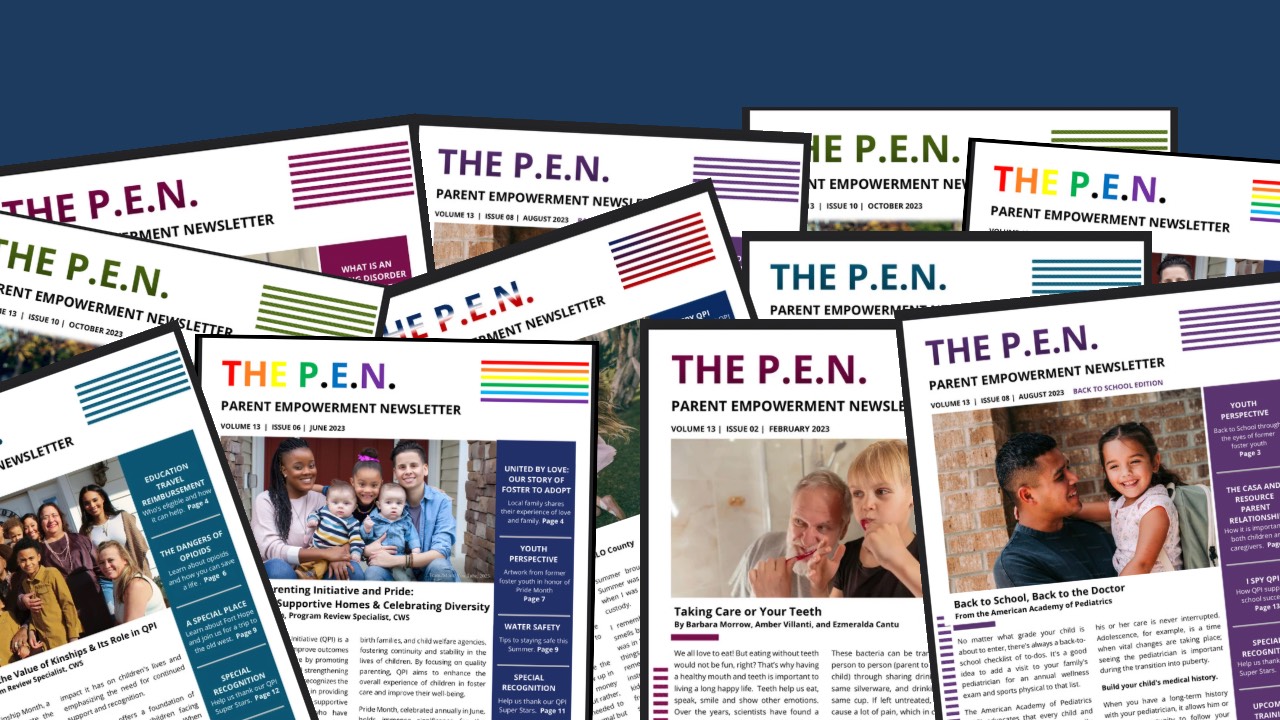
The P.E.N. is the department’s monthly newsletter where parenting tips, youth enrichment activities, local resources and more are shared!
Every month, the department publishes a newsletter full of information and resources for youth in care, resource parents and birth parents! If you are interested in receiving this newsletter, click the subscribe button!
Quality Parenting Initiative

The goal of California’s QPI is to strengthen foster care by focusing on excellent parenting for all children in the child welfare system. We believe that by offering the best possible services to our resource parents, we will attract and retain the highest caliber of resource parents in our state.
QPI is an approach, a philosophy and a network of sites that share information and ideas about how to improve parenting as well as an effort to rebrand foster care, not simply by changing a logo or an advertisement, but by changing the expectations of and support for caregivers.
If you are interested in becoming involved in our QPI collaborative which meets quarterly, please contact us at (805) 781-1938.
Resource Family Approval

Thinking about becoming a caregiver? This page explains the RFA process, which prepares and approves families to provide safe, stable, and loving homes for children in foster care.
About Resource Family Approval
Resource Family Approval (RFA) is a streamlined, family-friendly and child-centered certification process to approve care providers for children placed in out of home care. RFA was implemented in San Luis Obispo County in November, 2013 and statewide in January, 2017.
RFA creates unified approval standards for all caregivers, so children in out of home care will be better positioned to find permanency more quickly.
The RFA process includes a home and grounds safety check, background checks, a comprehensive psychosocial assessment, and training for all families, including relatives. The process prepares families to better meet the needs of vulnerable children in the foster care system, decreases disruptions, improves caregiver satisfaction, and supports a more seamless transition to permanency.
Apply to Become a Resource Parent
To become certified as a resource parent, please contact us at (805) 781-1705 for further information.
Applicants can expect to complete LiveScan fingerprinting and several levels of background checks, initial Resource Family Training (RFT) and annual training requirements (including obtaining and maintaining CPR/First Aid Certification), a home and grounds inspection, and a comprehensive psychosocial assessment.
Timeline Information
Here’s a general timeline for fostering a child in the state of California:
1. Initial Inquiry: The process begins with an individual or couple expressing interest in becoming resource parents. They can do so by calling (805) 781-1705 or submitting their interest via our online eform.
2. Resource Family Training: Prospective resource parents must complete a series of pre-certification training classes.
3. Application and Home Study: After completing the training, the prospective resource parents submit an application. A social worker then conducts a thorough home study, which includes interviews, background checks, and an assessment of the home environment to ensure it meets safety standards.
4. Approval and Certification: Once the home study is completed, it is reviewed, and if everything is in order, the prospective resource parents are approved and certified.
5. Matching Process: The approval opens the possibility of being matched with a foster child who is a suitable fit for the family’s capabilities and the child’s needs. Social workers or agencies work to find an appropriate match based on the resource parent’s preferences and the child’s needs.
6. Placement: Once a suitable match is found, the child is placed with the resource family. This process may be immediate or take some time, depending on the availability of suitable matches.
7. Ongoing Support and Training: Resource parents receive ongoing support, resources, and training to help them navigate the challenges and responsibilities of fostering a child. This support aims to ensure the well-being of both the child and the resource family.
8. Reunification or Permanency: The ultimate goal of foster care is reunification with the child’s birth family if possible. However, if reunification is not feasible, the resource family may choose to pursue adoption or other forms of permanency, depending on the child’s situation.
Foster Support

We understand that fostering can be a big commitment for our resource parents and are committed to providing the resources necessary to support our resource parents in their journey of fostering!
California Foster Care Ombudsperson
Provides a voice to speak and act on behalf of youth in foster care and can provide information on the rights of youth in care. Call the Toll Free Help Line at (877) 846-1602 or email fosteryouthhelp@dss.ca.gov
Foster Support Unit
This unit is designed to provide an additional level of support for resource parents by being able to take care of resource parent’s requests for information, general questions, and requests for referrals for certain items. To reach the Foster Support Unit, call (805) 781-1917.
Caregiver Training
Foster and Kinship Care Education (FKCE)
Provides training and workshops for resource parents as part of the child-centered Resource Family Approval process. Classes cover a variety of required topics, including the child welfare and probation systems, supporting the cultural needs of children, birth parent relationships, grief and loss, behavioral supports for children impacted by trauma, permanence planning, and educational needs.
If you’re interested in attending classes, subcribe to our Parent Empowerment Newsletter.
Foster Parent College
Provides innovative, interactive online training courses for
foster, adoptive, and kinship caregivers. Self-paced courses are available 24/7 and cover a wide range of caregiving and child well-being topics.
Click here to visit their website.
Additional Resources
California Alliance of Caregivers
The California Alliance of Caregivers website offers a range of events and trainings designed to support caregivers across California. These include workshops, support groups, and educational sessions that help caregivers build practical skills, connect with others in similar roles, and access up-to-date information on caregiving topics. The site serves as a hub for ongoing learning, community connection, and resources to help caregivers feel more supported and informed in their role. To visit the website, click here.
Child Passenger Safety Checks
Certified Child Passenger Safety Technicians provide education, car seat checks, and installation assistance. Services help caregivers select the appropriate seat, determine proper placement and positioning, and ensure correct installation.
For more information call our certified Child Passenger Safety Technician at (805) 788-2808 or email clounder@co.slo.ca.us
Children’s Resource Network of the Central Coast
Children’s Resource Network of the Central Coast works with community partners to provide clothing and essential items, helping resource parents support children during times of transition or hardship.
To get connected, call (805) 709-8673 or email info@childrensresourcenetwork.org
DSS Resource Hub
Provides timely access to essential, tangible items for youth and
resource families experiencing immediate need. Resources may include clothing, diapers, infant supplies, toys, home goods, and other critical items that help support stability and well-being during times of transition.
To make a request, contact foster support (805) 781-1917 or reach out to your social worker!
Enrichment Activities
Monthly enrichment activities bring together youth in care and
their resource families to foster connection and community. Activities are invitation-based and include the biological children living in the resource home.
To be notified of events, subscribe to the Parent Empowerment Newsletter.
For Goodness Cakes
For Goodness Cakes provides birthday and celebration cakes for youth in care. Local volunteer bakers prepare and deliver cakes directly to social workers across all six county offices, helping ensure youth feel celebrated and valued.
Talk to your social worker to learn more!
Foster Parent Association
Membership in a local foster parent association includes automatic membership in the California State Foster Parent Association (CSFPA). Benefits include a membership card, voting rights, discounts on the annual training conference, access to statewide committees, quarterly newsletters, advocacy efforts, and support for education and funding that benefits foster youth across California.
Contact: Karen Cathcart
Email: slofosterparentassociation@gmail.com
Operation Santa
An annual Department of Social Services holiday gift drive that
provides new toys, gifts, and essential items to youth in care, helping ensure children feel supported and remembered during the holiday season.
Childcare

Explore programs, financial assistance, and helpful information to ensure children in your care have access to safe, reliable, and nurturing childcare.
Bridge Childcare Program
The Emergency Child Care Bridge Program provides temporary child care assistance to eligible families involved in the child welfare system, including birth parents under juvenile court jurisdiction. The program helps families access stable child care while working toward long-term solutions.
Who Is Eligible?
- Approved resource families
- Family placements in an emergency or for a compelling reason (often relative caregivers)
- Parents under the jurisdiction of the juvenile court, including nonminor dependent parents
What Does the Program Offer?
-
Child Care Vouchers: Temporary assistance with child care costs.
-
Child Care Navigation: Help finding and accessing child care.
-
Trauma-Informed Care: Training for child care providers to support children’s needs.
Click on the flyers to learn more!
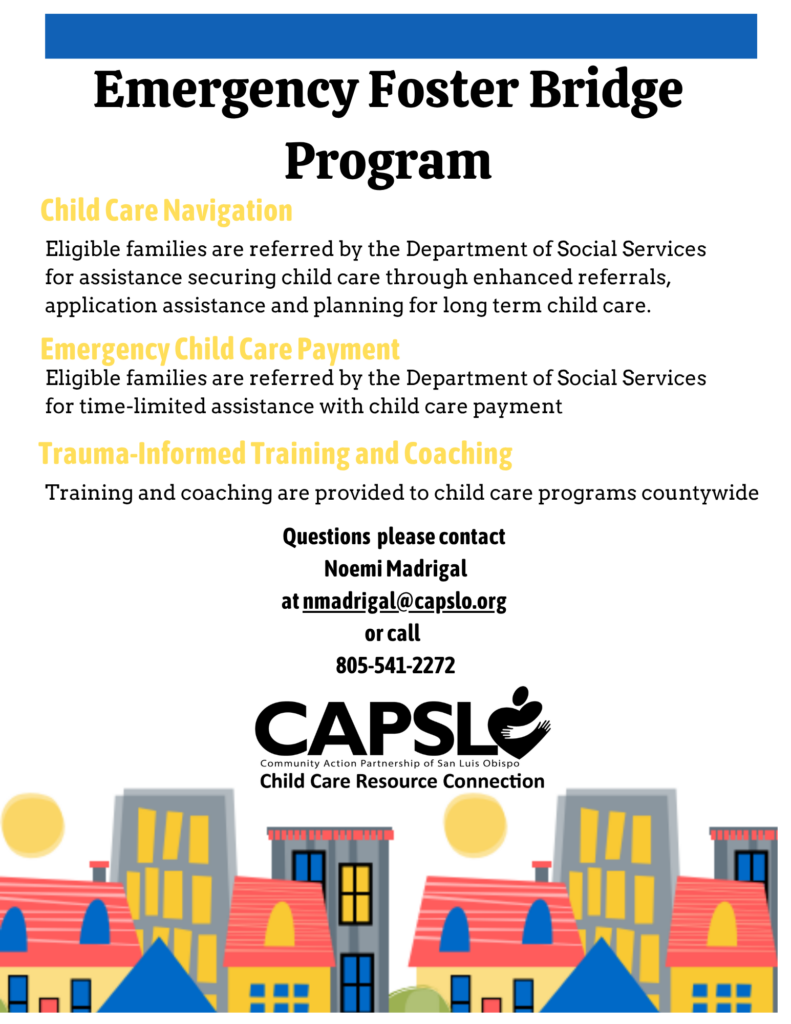
Bridge Childcare (English)
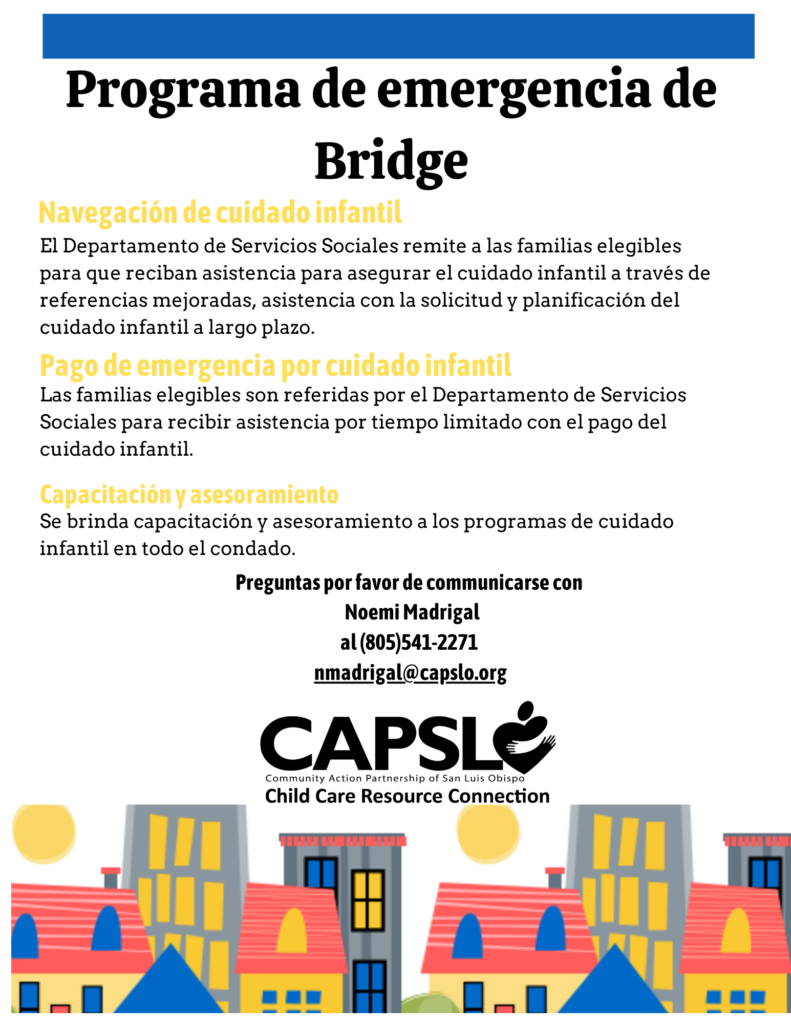
Bridge Childcare (Spanish)


CAPSLO Childcare Resource Connection
CAPSLO Child Care Resource Connection
The CAPSLO Child Care Resource Connectionis a webpage that offers a variety of resources pertaining to childcare, including:
- Assistance with child care payments
- Finding child care
- Online tools to manage child care services
We Are the Care Initiative
We Are the Care Initiative
The We Are the Care Initiative is a coalition in San Luis Obispo County that is commited to providing affordable, quality child care to families in the county.
We Are the Care SLO County encouragies parents looking for child care to call (805) 541-2272.
Training Opportunities

County of SLO Training
It’s important for resource parents to actively participate in training opportunities to enhance their knowledge and skills as caregivers. Training not only benefits the children in their care, but also provides valuable support and resources throughout their journey.
To find out about available training opportunities, call your social worker, or (805) 781-1705.
CalTrin
CalTrin offers free training, tools, and ongoing support for resource parents across California. Their programs help caregivers build skills in trauma-informed care, understand the child welfare system, and connect with a community of other caregivers to better support the children and youth in their care.
How to Become a Resource Parent
Are you ready to take the next step and make a difference in a child or teen’s life?
The process to become a resource parent typically takes around 90 days, but there are many factors that can affect your timeline. If you decide to make a difference in the life of a youth in foster care and move forward with the application process, the department will assist you and support you through the process!
You can begin the application process by calling (805) 781-1705 or submitting your interest via our online eform.
Click on the brochures below for more information!